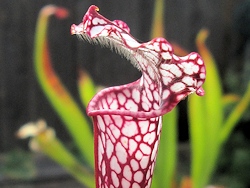
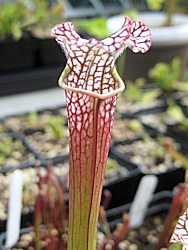
Sarracenia


The North American Pitcher plants differ greatly from their tropical Nepenthes cousins. Sarracenia are temperate plants that produce a variety of colorful and hollow leaves that form pitfall traps. Insects feed on nectar along the edges of the slippery mouth of the pitchers, lose their precarious balance and fall into the pitchers, from which they are unable to escape. The pitchers then digest the insects, either by way of enzymes secreted by the leaf, or through the help of bacteria, depending on the species.

Sarracenia pitchers are shaped directly from the whole leaf, unlike Nepenthes, whose pitchers develop from the tendril at the very end of the leaf tip. Being temperate, Sarracenia plants require a period of winter dormancy, much as Dionaea do. Additionally, Sarracenia grow beautiful drooping flowers which can be pollinated by insects, hand-pollinated, or manually cross-pollinated to produce a beautiful array of hybrids, many of which are maintained in cultivation.

As of July 2014, we are deeply pleased to announce a collaboration with Long Island carnivorous plant nursery Seemore Carnivorous Gardens! In addition to our own plants, we will be offering monthly pre-orders on plants from their collection, with no additional markup of their prices. For these plants, look for "" in the plant descriptions.

Midtown Carnivores
will be closed from
August 21st through September 7th.


Sarracenia species
 
  Sarracenia hybrids
 

 Sarracenia flava
 Sarracenia flava var. maxima


 Sarracenia x catesbaei

 Sarracenia flava var. rubricorpora
 Sarracenia leucophylla 'red'

   Sarracenia 'Doodle Bug'                  
 Sarracenia leucophylla 'Tarnok'  

 Sarracenia 'Jessica'

 Sarracenia minor    Sarracenia 'Reptilian Rose'
 Sarracenia minor var. okeefenokeensis    
 Sarracenia oreophila    
 Sarracenia purpurea ssp. purpurea    
   Sarracenia purpurea 'Jersey Girl'


SARRACENIA SPECIES

Sarracenia flava
The Yellow Pitcher Plant and its genetic variants
The Yellow Pitcher Plant is a species that produces upright trumpet pitchers. The plant produces tall, tall, hollow green pitcher leaves, which lure insects that fall in and are digested. The plant produces yellow flowers in the spring.
 
Seasonal pitcher cycle:
Spring - pitchers and yellow flower
Early summer - pitchers
Late summer - phyllodia (flat leaves)
Autumn - phyllodia (flat leaves)
 
Requires winter dormancy periodGrows well outdoors under full sun

Plant care information (.pdf):

Feeding guide:    -   Dormancy care:


Sarracenia flava (typical) 
The Yellow Pitcher Plant
Alternatively described as Sarracenia flava var. flava

Yellowish-green pitchers, maroon veining, flowers early in the Spring.


sold out

Sarracenia flava var. maxima 
The Yellow Pitcher Plant

Anthocyanin-free variant. Yellowish-green pitchers, no veining, flowers early in the Spring.
 
Small division, 3.5" pot: sold out


Sarracenia flava var. rubricorpora 
'Select Dark Red' clone, Liberty Co. FL

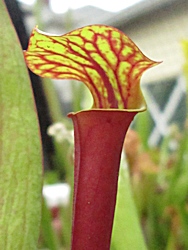
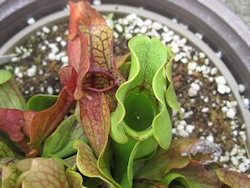
Pitchers with yellow/green hoods with maroon veining. The pitcher tube exhibits significant maroon coloration in the Spring (right pic), with later-season pitcher growing will solid maroon color in the late summer (left pic).


Small division
, 3.5" pot: $17 (only one available)


Sarracenia leucophylla
The White-topped pitcher plant and its genetic variants
S. leucophylla is one of the most colorful and vibrant of the trumpet pitcher species. This plant and its many varieties are known for its brilliant white patterning along its pitchers, with various clones having different colors and patterns.
 

Seasonal pitcher cycle:
Spring - phyllodia (flat leaves) and flower
Early summer - thin pitchers
Late summer - wide pitchers
Autumn - wide pitchers


Plant care information (.pdf):
Feeding guide:    -   Dormancy care:


Sarracenia leucophylla "red" 
Red clone

Thin magenta-and-red topped pitchers in the Spring (left pic). Wide magenta-white-and-green topped pitchers in the Autumn (right pic). Crimson-petalled flower.


Sold out for 2016.

 
Sarracenia leucophylla 'Tarnok' 
Floral mutant cultivar

Noted for its mutant flower which produces rows of sepals with no petals.

Sold out for 2016.


Sarracenia minor
The hooded pitcher plant and its genetic variants

Unlike the other upright trumpet pitchers, S. minor produces pitchers whose lids resemble a hood. The hooded lids curve over the opening of the pitcher openings. The back of the pitchers have a white, areolated pattern, which allows sunlight through. Insects which are lured into the pitchers see the light shining through what they believe to be escape windows, providing misdirection to the prey.
 

Seasonal pitcher cycle:
Spring - pitchers and flower
Early summer - pitchers
Late summer - phyllodia (flat leaves)
Autumn - phyllodia (flat leaves)


Plant care information (.pdf):
Feeding guide:    -   Dormancy care:


Sarracenia minor  

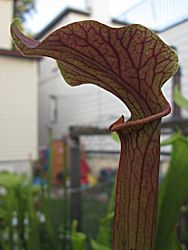
Tall, green pitchers with maroon patterning and translucent white patterned patches at the back of each pitcher. Crimson-petalled flower.


Sold out for Spring, 2016. Divisions may be available later in the year.

 
Sarracenia minor var. okeefenokeensis 
(Ware County, GA)

A vigorous and large-pitchered genetic variant.

Medium, 4.5" pot: $17


Sarracenia oreophila "Alabama"
Green pitcher plant, Endangered species

NY SALES ONLY. Courier Delivery only.

This endangered species is renowned for its large and vigorous green pitchers with maroon patterning. It is often used in hybrid crosses to add size and vigor to the resulting offspring. In compliance with Federal law, this is only eligible for sale in NY.


Medium division, 4.5" pot: $35
Please call/email for availability.


Plant care information (.pdf):
Feeding guide:    -   Dormancy care:


Sales suspended for winter dormancy.  
Sales suspended for winter dormancy.   --> -->
Sarracenia purpurea
The Purple Pitcher Plant
and genetic variants
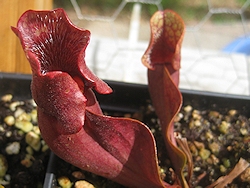
The Purple Pitcher Plant is a species of cold-hardy Sarracenia that are found as far north as Canada. It produces recumbent, open pitchers that hug the ground as a large rosette. S. purpurea are one of the few species of Sarracenia that collects and holds rainwater. Insects that are attracted to the nectars secreted by the lip of the pitcher fall in and drown. The insects are broken down partially by enzymes secreted by the leaves, but primarily by bacteria. The nutrients are then absorbed into the leaves. Flowers are typically maroon with crimson petals, except for Burk's purple pitcher (now known as S. rosea), which has pink petals.
Seasonal pitcher cycle:
Spring - pitchers and flower
Summer - pitchers
Autumn - pitchers


Plant care information (.pdf):
Feeding guide:    -   Dormancy care:


  Sarracenia purpurea ssp. purpurea 
The Northern Purple Pitcher Plant

Winter-hardy subspecies, most cold-tolerant, endemic to the Northeastern United States and Canada. Clone is green and maroon with veining,


Small division
, 3.5" pot: $12 

  Sarracenia purpurea "Jersey Girl" 

Deep maroon coloration and with yellow patterning on its hoods.

3" pot: $15.99 - preorder only



SARRACENIA HYBRIDS


Sarracenia x catesbaei
Seed-grown Hybrid Pitcher Plant


This is a naturally occuring hybrid of S. flava x S. purpurea. Each of these plants are seed-grown, and as such, no two are exactly alike.


3" pot as shown: $15.99 - preorder available

Plant care information (.pdf):

Feeding guide:    -   Dormancy care:


Sarracenia 'Doodle Bug'
Hybrid Pitcher Plant


Alternatively described as 'Sarracenia 'Doodlebug'. This is a specific clone of S. alabamensis ssp. alabamensis x S. psittacina, which is currently under patent review. The plant produces highly colorful and deeply hooded pitchers of a red and white pattern.


3" pot as shown:
$15.99 - preorder available

Plant care information (.pdf):

Feeding guide:    -   Dormancy care:


Sarracenia 'Jessica'
Cultivated clone of Sarracenia x areolata

This is a specific clone of a cross between Sarracenia alata and Sarracenia leucophylla. This clone was created by master grower Jerry Addington, and its formal cultivar description was published in 2009.


sold out for 2016


Plant care information (.pdf):

Feeding guide:    -   Dormancy care:


Sarracenia 'Reptilian Rose'
Cultivated hybrid clone

'Reptilian Rose' is a select clone isolated from a cross between Sarracenia 'Royal Ruby' and Sarracenia oreophila "Sand Mountain", created and isolated by master grower Phil Faulisi. Its formal cultivar description was published in 2009.  


4.5" pot, Medium division:
$40

Plant care information (.pdf):

Feeding guide:    -   Dormancy care:


Symbol Legend  


Requires a period of winter dormancy each year. For more information, see the care sheet for each plant.
Grows well indoors under fluorescent lighting.
Grows well on a sunny south- or east-facing windowsill year-round.
Grows well outdoors under full sun, but should be brought indoors in the winter.